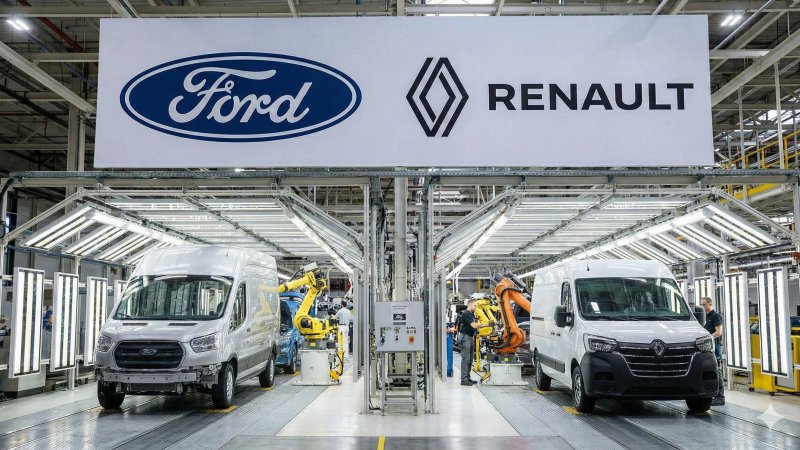







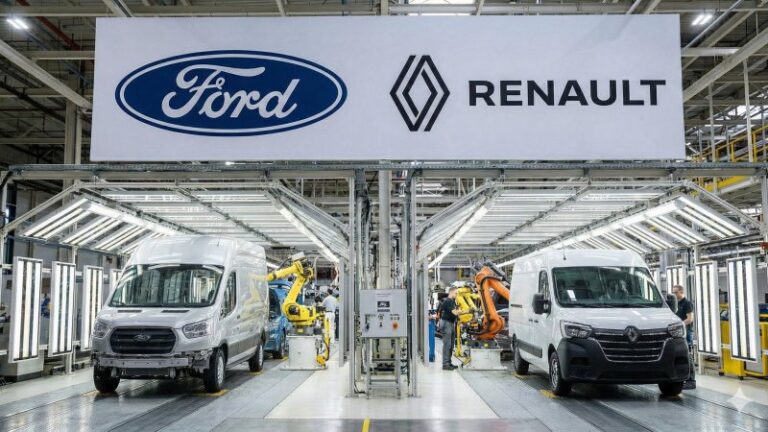
The joint announcement released by Renault and Ford on 9 December 2025 marks a significant step in the industrial reshaping of electric vehicle manufacturing in Europe. Renault Group and Ford have formalised a collaboration set to influence the continent’s production structure, combining the development of two electric cars with an assessment of future cooperation on light commercial vehicles. The agreement comes at a time when Europe’s electric market is progressing at uneven speed, while global competition and regulatory pressure on decarbonisation are pushing the industry to rethink its industrial strategies.
At the centre of the agreement is the design of two Ford models based on Renault’s Ampere platform. According to the two manufacturers, the vehicles will be jointly developed and built at the ElectriCity hub in northern France, where Renault has concentrated its main electric mobility activities in recent years. Producing in France enables Ford to consolidate its industrial presence in Europe by relying on a specialised, fully operational infrastructure, while Renault strengthens the value of its investment in the Ampere platform and the associated industrial ecosystem. The first Ford model is expected in dealerships at the start of 2028.
The cooperation goes beyond a simple technological transfer. Ford will retain its own design language and the brand’s typical driving dynamics, while integrating Renault’s expertise in electric vehicle production. The partnership is presented as a way to contain costs, shorten development times and improve predictability in production capacity, all crucial factors at a time marked by new entrants and the need for substantial investment in dedicated platforms.
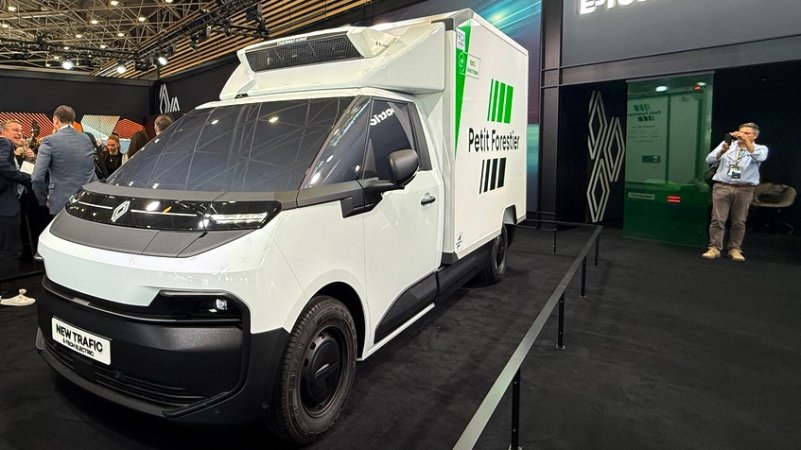
Renault Group and Ford have also signed a letter of intent to assess European cooperation on light commercial vehicles, a strategic segment for last-mile urban logistics and local transport. The idea is to design and produce models for both Ford and Renault, aiming to achieve economies of scale and a more agile industrial process. Such cooperation could influence the offer of compact and mid-size electric vans, a segment expected to grow with the expansion of e-commerce and increasingly stringent urban emissions rules.
According to François Provost, chief executive of Renault Group, the agreement aims to make European production more competitive by combining Ampere technologies with shared industrial processes. Jim Farley, president and chief executive of Ford Motor Company, stressed that the partnership supports the group’s European strategy, targeting a more efficient operation aligned with future market challenges.
The cooperation is built on a shared infrastructure of suppliers, software, production processes and logistics systems. The Ampere platform, designed to integrate modular components with a high level of standardisation across models, reduces complexity and costs throughout the supply chain, enabling more predictable production and better utilisation of facilities. The ElectriCity hub, bringing together three sites in northern France, is designed to support high volumes and more regular delivery times—key elements for a sector rethinking its industrial flows to adapt to electrification.
Massimiliano Barberis