






On 14 December 2025, Medway, the rail operator controlled by MSC, began operations in France with a service dedicated to the transport of raw materials between Caffiers and Dunkirk. This marks a direct extension of its European network, already active in nine countries, particularly across the Iberian Peninsula and Central and Eastern Europe. The move enables the MSC Group to further integrate rail freight into its logistics chain, alongside its maritime and terminal operations.
To support its entry into France, Medway has planned a total investment of around €45 million for the acquisition of eight locomotives and 350 intermodal wagons. The rolling stock is intended for medium- and long-haul services, with a particular focus on intermodal flows linked to Northern European ports and connections with the Iberian Peninsula. The investment is part of the group’s organic growth strategy, which emphasises direct control of rail assets to ensure operational continuity and the ability to adapt to market demand.
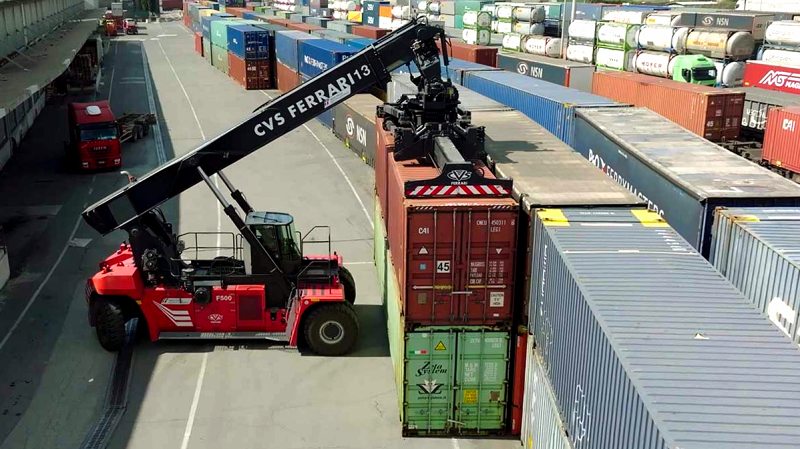
A central role in the French strategy is assigned to the Paris-Bruyères trimodal terminal, developed by Medlog, the logistics arm of the MSC Group. The terminal is designed to integrate rail, inland waterway and road transport, directly linking the Paris metropolitan area with the port of Le Havre and other European logistics corridors. The platform allows container flows to be consolidated and redistributed, reducing reliance on road transport alone for long-distance movements.
The entry into the French market fits into a plan developed over recent years, particularly through the strengthening of the Spain–France axis. As early as 2023, Medlog, via its subsidiary Medway, was selected as the strategic partner of Renfe Mercancías. The alliance, approved by Renfe’s board of directors, aims to relaunch Spanish rail freight and to transform Renfe Mercancías into an integrated logistics operator with an international footprint. Medlog was chosen at the end of a competitive process that also involved other major logistics and maritime groups.
In that context, Medway’s president, Carlos Vasconcelos, highlighted the imminent entry into the French market and the group’s investment capacity as key elements of the partnership. Extending operations beyond the Pyrenees is seen as instrumental to the development of continuous rail flows between Spanish ports, France and the rest of Europe, leveraging the integration of maritime transport, rail services and inland terminals.
The infrastructure framework between Spain and France has meanwhile been strengthened through institutional agreements. A bilateral accord signed in January 2023 opened the French rail network to Spanish trains, providing for direct services between Madrid and Marseille and between Barcelona and Lyon. These are complemented by projects to upgrade cross-border infrastructure, such as the Pajares bypass and the reopening of the Bedous–Canfranc link, including the adoption of dual gauge to facilitate international freight traffic.