
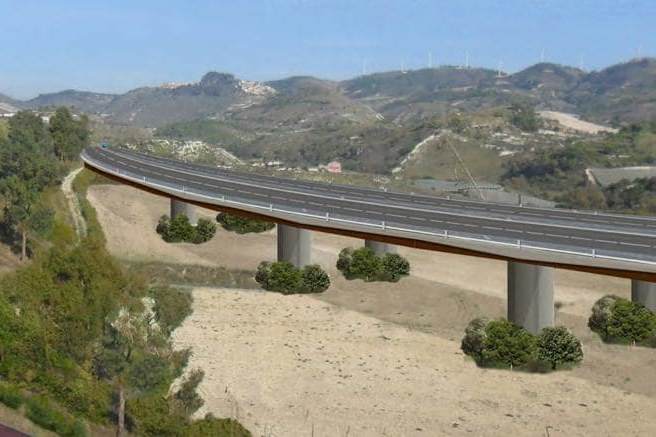




From 17 August 2025 the H4 motorway has been closed to vehicles weighing more than 3.5 tonnes between Razdrto and Vipava. This stretch, about ten kilometres long, runs through the Vipava valley and connects the junction with the A1 motorway at Razdrto, at the foot of Mount Nanos, towards the north-west in the direction of Vipava, before continuing towards Ajdovščina, Šempeter pri Gorici/Vrtojba and the border with Italy at Gorizia. It is therefore the eastern section of the H4, between the A1 route from Ljubljana to Koper and the town of Vipava. The works include the reconstruction of the Rebernice viaduct, deemed urgent because of the area’s geological instability, the installation of new wind barriers to cut in half the 20 to 25 days of closures caused each year by the bora winds, and the complete resurfacing of the carriageway.
The closure is planned in two phases. The first, between August and November 2025, will last one hundred days, during which the carriageway heading towards Italy and Gorizia is completely closed to lorries weighing over 3.5 tonnes. The second phase is scheduled for the end of July 2026 and will last an estimated 120 days. In total, the artery linking Slovenia to the Gorizia freight terminal will be disrupted for more than seven months.
The first stage of works has brought bans for all heavy vehicles over 3.5 tonnes heading towards the Vrtojba/Sant’Andrea border crossing at Gorizia. Trucks have been diverted onto Slovenia’s A1 motorway, forcing them to continue towards the Sežana/Fernetti crossing in the province of Trieste. Local Slovenian traffic, including lorries with destinations within the area, is allowed to use the regional road through the Vipava valley, but this alternative has a limited capacity of just 200 to 500 vehicles per day and is unable to absorb international traffic.
Italian authorities asked their Slovenian counterparts to allow heavy vehicles to use secondary roads within Slovenia, but the request was denied on the grounds that such routes were inadequate for a flow of 300 to 400 lorries a day. The motorway company Dars and Slovenia’s transport ministry therefore diverted all heavy traffic towards Fernetti. The Slovenian police stepped up checks on regional roads, particularly in the first weeks, to ensure compliance with the ban.
Authorities have estimated that the Fernetti crossing may have to handle up to 4,000 additional lorries a day at peak times. Traffic then converges on the Trieste motorway link, putting heavy strain on the Lisert toll barrier, which has only four entry gates to the A4. Figures from the very first day of closure illustrate the immediate critical impact, with queues of five to six kilometres at Lisert and a 42 per cent increase in heavy vehicle crossings, rising from 3,600 to over 5,100 trucks per day. On peak days the queues stretch along the entire right-hand lane from the border to the A4 entry point, causing significant slowdowns, especially on Tuesdays and Sundays. Border checks, reinstated following the temporary suspension of the Schengen agreements, further worsen waiting times.
This situation is creating additional costs for international haulage companies because of longer travel times due to compulsory detours, higher fuel consumption on extended alternative routes, delivery delays that undermine competitiveness and the risk of fines for violating transit bans. Hauliers are having to completely reorganise their logistics routes for a total period of seven months.
For this period the Friuli Venezia Giulia region has approved an extraordinary €500,000 plan to support the Sdag freight terminal in Gorizia. Measures include free parking for all industrial vehicles at the terminal for the entire duration of the works, reduced motorway tolls on the A4 section between Lisert and Villesse to encourage transit towards Gorizia, free access to equipped rest areas to facilitate customs operations, expansion to two lanes at the Fernetti border crossing, and increased customs staff to speed up frontier checks.
Italian and Slovenian authorities have set up a permanent technical committee to monitor the situation and implement corrective measures where necessary. The Italian ambassador in Ljubljana, Vincenzo Celeste, has played an active role in negotiations to find joint solutions. One proposal is for a quota system for heavy traffic on the Slovenian side before the Fernetti border, to prevent excessive queues on the Italian network. However, implementing such a system would require complex technical coordination.