




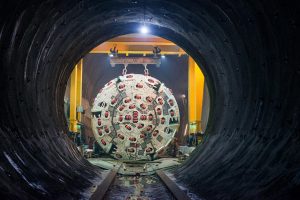
On 18 September 2025 will mark a highly symbolic milestone in the construction of the Brenner base tunnel. The completion of the exploratory tunnel will be the first of the three galleries to reach the finishing line, allowing Italy and Austria to be connected beneath the mountain without interruption. The exploratory tunnel runs from end to end, positioned between the two main tunnels about twelve metres below them.
From the outset, this gallery has provided valuable geological information during excavation and has served as a logistical and service corridor in the construction phase. Once the works are completed, it will function as a maintenance and drainage gallery during the regular operation of the Brenner base tunnel. Alongside the exploratory tunnel, excavation of the main galleries in Austria is progressing southwards towards the Italian border, where mechanical boring machines completed their work in May 2025, bringing the Italian civil works to a close.
This first achievement, although undeniably positive, cannot overshadow the fact that the new cross-border railway corridor linking Verona with Munich is still missing a crucial element: the Bavarian section leading to the Austrian border. Unless addressed, this gap risks turning the access into Bavaria into a bottleneck. To put pressure on Berlin and demand a decision on a project that has never taken off, business associations directly affected have stepped forward.
A joint statement was signed by Confindustria Alto Adige, the Bavarian Business Association Vbw and the Tyrolean Industrial Association IV Tirol. According to Vbw, it is unacceptable that the 55-kilometre base tunnel under the Alps (extended to 64 kilometres if the Innsbruck freight bypass is included) should be completed far more quickly than a section of comparable length that partly runs above ground. The German Parliament must decide on the alignment, they argue, because it is only a matter of time before bottlenecks at the Brenner turn into a full-blown collapse of traffic across the Alps.
In the view of industry representatives, if the northern access section in Germany does not move forward, the much-anticipated shift of freight to rail risks remaining an unfulfilled promise. It would also be a mistake to consider the completion of the Brenner base tunnel as the final and definitive stage of the new railway corridor between Italy and Germany while leaving the access lines unchanged.
The German section remains the unresolved issue, in sharp contrast with Austria and Italy, where commitments are being pursued with relative diligence. After building the Innsbruck freight bypass in 1994, Austrian rail operator ÖBB opened in 2012 a first 40-kilometre stretch in the Lower Inn Valley, from the northern portal of the bypass to Radfeld-Kundl, just south of Wörgl. In 2023 the focus shifted to the next stretch between Radfeld and Schaftenau, only a few kilometres from Kufstein on the Austrian-German border.
Italy too has moved from blueprints to construction sites, with the priority section between Fortezza, the southern portal of the base tunnel, and Ponte Gardena now under way. Following that, work has started on the Trento freight bypass, where in autumn 2025 the first of four mechanical boring machines will be assembled to dig the twin 12-kilometre tunnels beneath the Trentino capital.
Piermario Curti Sacchi