



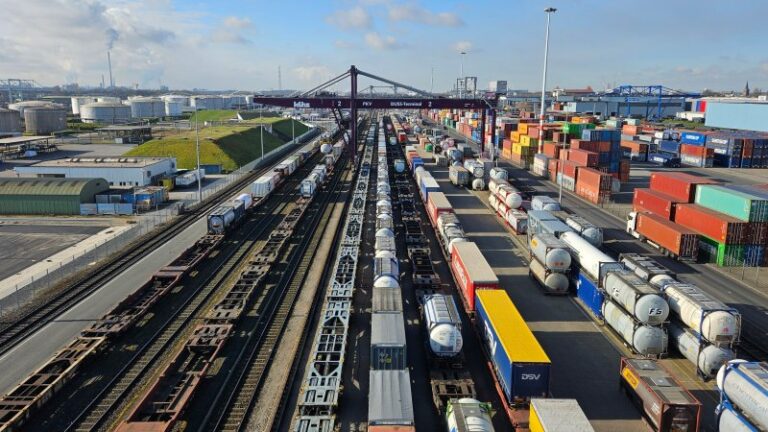
On 1 January 2026 the Pkv terminal at Duisburg-Ruhrort Hafen will enter a new phase in its history. Management of the facility, a central node in the intermodal network across the Ruhr basin, will transfer from the Duss consortium (Deutsche Umschlaggesellschaft Schiene-Straße) to the intermodal operator Kombiverkehr, and the terminal will be rebranded as Rail Hub Duisburg. The facility operates trains serving more than twenty European countries, making it a primary platform for continental flows.
Ownership of the terminal has rested with Planungsgesellschaft Kombinierter Verkehr (Pkv) since 1991. The site became operational the following year amid strong expansion of combined transport in Germany. In 2003 operational responsibility was handed to Duss, a company in which Kombiverkehr held a 12.5 per cent stake. After more than two decades, operational control will now return directly to the German intermodal group through its subsidiary Kombiverkehr Intermodal Services Duisburg. According to CEO Heiko Krebs, more than 95 per cent of the terminal’s traffic already stems from Kombiverkehr.
The terminal covers an operational area of around 85,000 square metres, with three gantry cranes serving eight tracks and an additional track equipped with a reach stacker. This equipment enables rapid transfer of intermodal units between trains or between road and rail, with a theoretical annual capacity of 200,000 units. From autumn 2025 a new crane fitted with a special spreader capable of handling tank containers up to 75 tonnes will come into service, an investment that broadens operational possibilities particularly for hazardous goods and heavy or oversized loads. The terminal also features external storage areas beyond the crane field, including two tanks for the temporary holding of hazardous goods related to transport.
Situated in the heart of the Ruhr, the terminal has direct links to major German motorways including the A3, A40, A42 and A59, and lies close to the Oberhausen-Osterfeld rail yard. The company says the new management will respond more quickly to customer needs, further promoting the shift of freight to rail, while guaranteeing non-discriminatory access to the facility for other operators and maintaining the site as an open and competitive hub.