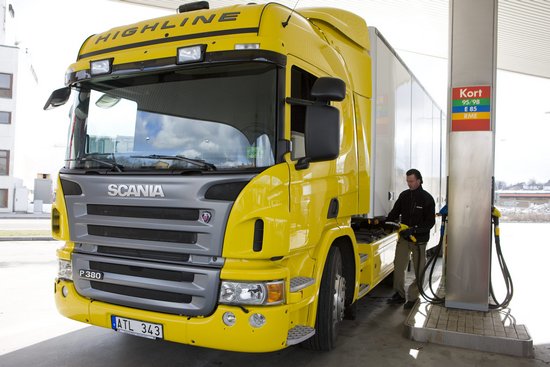






The Ukrainian branch of the Scania brand recently hosted the national women's championship for driving industrial vehicles. This competition is part of a broader initiative, as reported by the Polish portal 40ton, co-funded by the Swedish government and linked to the need to rebuild the country after the ceasefire. The program, officially launched last year by the Swedish non-profit association Beredskapslyftet, is called "Reskilling Ukraine" and aims to support post-war reconstruction. Similar to what happened during World War II, the program's creators intend to promote women's employment in the transport sector to address the high volumes associated with reconstruction and the shortage of truck and bus drivers exacerbated by the number of war casualties.
In the initial phase of the program, free courses were organized in Kyiv and Ternopil for obtaining category C and D driver's licenses. The candidates had the opportunity to benefit from on-site accommodation, food, and free transfers from their homes. Priority was given to war veterans, women from military families, women displaced by hostilities, single mothers, and women over 50. The requirements to access the training include a category B driver's license, at least three years of car driving experience, and passing a short test with ten questions on traffic rules.
The competition organized by Scania, which has launched a similar initiative in Argentina in recent years, was one of the promotional elements of Reskilling Ukraine. The contenders had to demonstrate precision in driving a truck, knowledge of first aid rules, and theoretical and technical knowledge about vehicle preparation. The competition winner was awarded by Johan Forssell, Swedish Minister of Foreign Trade and Development Cooperation, who was in Ukraine to attend this event.
During the award ceremony, Oleksandra Panasiuk, coordinator of Reskilling Ukraine, stated, "We conducted a detailed study in various sectors and found that the demand for drivers is increasing daily in Ukraine. Many men are defending the country, including those working as heavy vehicle drivers. Both private and public companies are feeling the shortage of drivers, essential for maintaining critical infrastructure and business operations."
The project team also noted that unemployed women in Ukraine outnumber men and, according to official statistics, represent 70% of the total unemployed. For this reason, Reskilling Ukraine decided to give Ukrainian women the opportunity to retrain, learn a new profession, find employment, earn money, and contribute to the country's revival.
"We are very happy to give this opportunity to displaced women and those who have soldiers, veterans, or fallen in their families. Women over 50 are also a group we pay a lot of attention to," said Viktoria Posieva, communications manager of Reskilling Ukraine. "However, the most important factor for us in choosing participants is the motivation to change professions and start working as drivers. Any woman in Ukraine can enroll, and we have many contacts with major employers who offer a plan to adapt to the profession and are working to remove any obstacles for the new female staff. They are also willing to pay for additional training to obtain new licenses, offer paid internships, and are creating new locker rooms and automating various processes in their facilities so that women can work comfortably and without health risks."
Since the project began, 210 applications have been submitted for the BusDrive course and more than a thousand for the OnTrack course, dedicated to driving industrial vehicles. So far, 66 candidates have successfully completed the course and obtained their driver's licenses, while another hundred enrolled will participate in summer groups. The organizers aim to complete the training of three hundred new drivers by the end of 2024 and, if possible, extend the initiative through 2025.
Marco Martinelli