







Circle Group has announced a major upgrade to its Milos Intelligence suite to boost the use of predictive digital solutions for ports and intermodal hubs through integration with its proprietary Milos Tap (Truck Appointment Platform) and Milos Tfp (Transport Federative Platform). The initiative is part of a wider national programme for digital and sustainable innovation in logistics and forms part of the ongoing evolution of Port Community Systems, already interconnected with the Port Management Information System and the National Logistics Platform.
By June 2026, the system will be expanded with new features including dangerous goods management, supervision of common areas, interoperability with customs systems, predictive control of traffic flows via digital twins, an environmental dashboard, passenger management and vehicle arrival notifications. The aim is to create a digital logistics ecosystem that reduces human error, shortens waiting times, increases data traceability and enhances intermodality, in line with the principles of the ecological transition.
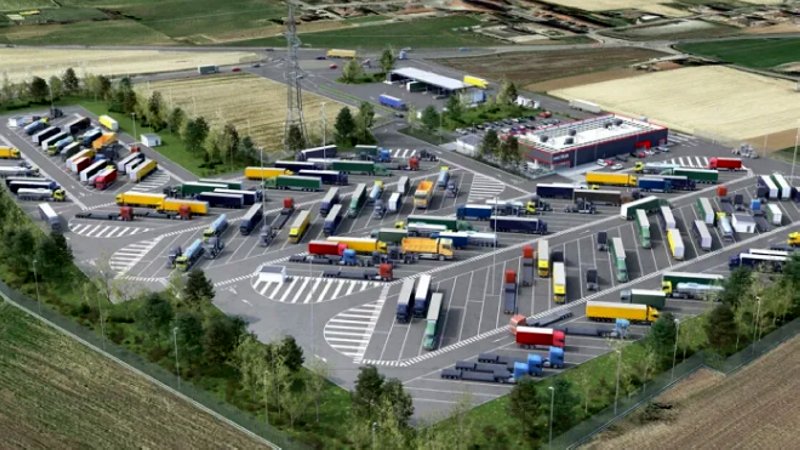
Milos Tap enables smart booking of terminal access slots for hauliers, improving vehicle flow and comparing planning and operations in real time. Milos Tfp, meanwhile, allows the tracking of traffic flows and dynamic simulations to support the management of congestion or operational disruptions. Together, the two platforms provide the information base for predictive models powered by artificial intelligence and machine learning, helping to forecast arrivals, stops and traffic volumes and to optimise the use of port resources.
The project’s implementation follows a structured path involving infrastructure and data analysis, digital architecture design, software development, testing and validation. Particular attention is given to scalability and compatibility with existing systems to ensure solutions can adapt to different operational contexts. A distinctive feature is the digital twin, a virtual model that reproduces in real time the movement of vehicles on a georeferenced map, allowing operators to quickly identify and correct any operational issues.
According to chairman and CEO Luca Abatello, the integration of Milos Intelligence offers a tangible tool to address the challenges of intermodality and sustainability, transforming the complexity of logistics flows into value through a predictive and integrated vision. The project forms part of the national and European logistics roadmap and aligns with the company’s industrial plan “Connect 4 Agile Growth”.
Circle Group has also announced the operational launch of its second intermodal terminal in Southern Europe as part of its logistics digitalisation programme. The new project will adopt the Tos (Terminal Operating System) and Gos (Generate Operating System) modules, the technological cores of the Milos and eXyond suites, under a contract worth around €500,000. The systems will be installed in two inland terminals — whose names have not been disclosed — with the aim of improving operational efficiency, digitalising handling processes and strengthening connectivity among supply chain operators.