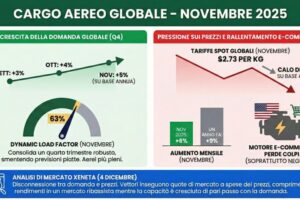

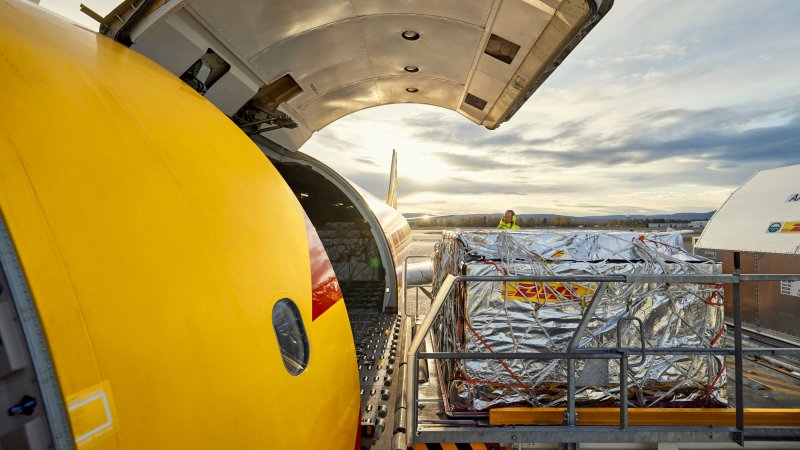






July 2025 brought an unexpected boost for air freight: a 5% annual rise, bucking the usual summer lull. According to analysis released by Xeneta on 6 August 2025, much of the demand was fuelled by companies seeking to circumvent US tariffs, fast-tracking shipments by air to avoid the longer transit times of ocean freight.
Demand growth outpaced the rise in capacity, which was up 3% year-on-year, pushing the dynamic load factor back to 58%, in line with 2024 levels. Despite this rebalancing, global spot rates fell for the third consecutive month, reaching 2.55 US dollars per kilogram, down 2% on the year, though a modest monthly rebound of 2% provided some relief for carriers. The gap between seasonal rates, covering contracts longer than a month, and spot prices widened from minus five to minus twenty cents in just two months, indicating limited medium-term confidence. New uncertainties are looming, as at the end of August the United States will scrap the de minimis exemption for all countries, a measure already applied on 2 May to China and Hong Kong, which triggered a 50% collapse in their low-cost e-commerce exports to the US.
Geographically, transpacific routes showed contrasting trends. South-east Asia to North America saw a 16% drop in spot rates to 4.87 dollars per kilogram, while prices from north-east Asia remained stable thanks to strong demand from Taiwan, which posted a 9% increase to 6.85 dollars per kilogram, driven by the boom in artificial intelligence and semiconductors. Towards Europe, stability in rates from north-east Asia at 4.16 dollars per kilogram was maintained by diverting cargo capacity from the Pacific to absorb a 90% surge in Chinese e-commerce. Conditions were tougher for south-east Asia to Europe, where prices plunged 22% to 3.02 dollars per kilogram. The Atlantic stood out as the only corridor posting significant rate increases in both directions, with westbound at 1.91 dollars per kilogram and eastbound at 1.15, supported by early shipments and reduced belly capacity on passenger flights.
According to Xeneta’s van de Wouw, confusion over trade policy is, paradoxically, one of the few factors likely to sustain air cargo demand in the coming months. When chaos hits global trade, air freight benefits, he said. But the piggybacking will not last. Too many questions remain unanswered: how long will uncertainty persist, and what will happen when American consumers start to feel the impact of tariffs on prices? As long as the rules remain unclear, companies will continue to buy time by shipping by air. But analysts warn that the day the political dance ends, volumes may also come back down to earth.